La fonction logarithme népérien est un pilier de l'analyse de terminale. Cette fiche réunit ses propriétés algébriques (ln(ab), ln(a/b), ln(aⁿ)), sa dérivée, ses limites clés et les croissances comparées comme x ln x → 0. En PC/SVT, ln apparaît dans les études de fonctions, les résolutions d'équations et souvent dans un calcul d'aire. Attention au domaine : ln n'est défini que pour x > 0 — pensez toujours à préciser l'ensemble de définition avant de dériver ou de résoudre.
Σ
Fiche de révision · 2ᵉ Bac PC / SVT
Fonction logarithme népérien
Math Excellence
1 · Définition & variations
Définition
Définie sur ]0,+∞[
Primitive de x1 nulle en 1
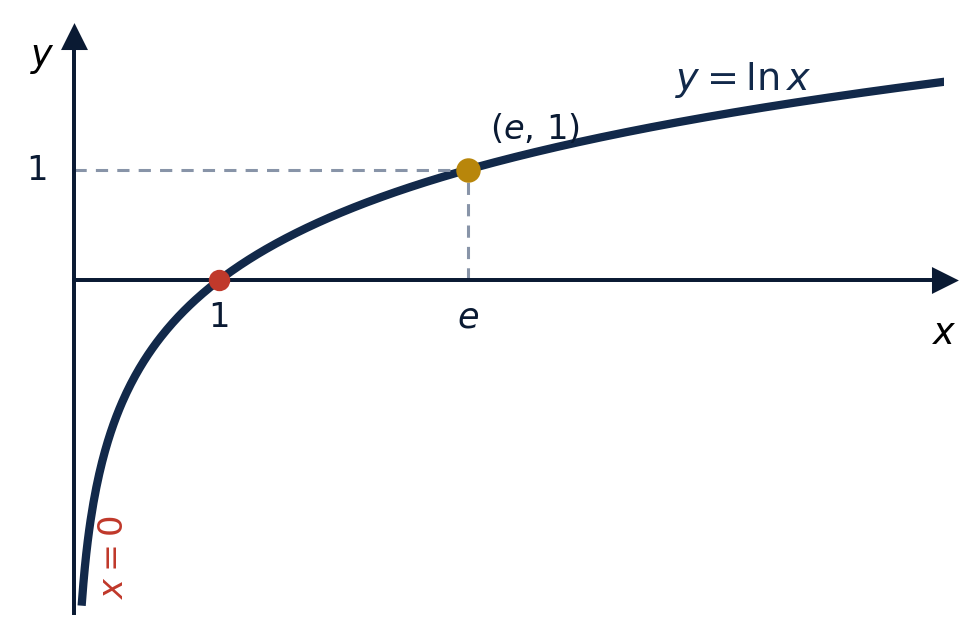
ln(1)=0,ln(e)=1
Sens de variation
(lnx)′=x1>0 sur ]0,+∞[
Strictement croissante
Concave : (\ln x)''=-\dfrac1{x^{2}}<0
Signe
lnx>0 si x>1
\ln x<0 si 0<x<1
Astuce :lnx=0⇔x=1.
Cln : asymptote verticale x=0, passe par (1,0) et (e,1).
2 · Propriétés algébriques
ln(ab)=lna+lnb
lnba=lna−lnb
lna1=−lna
ln(an)=nlna
lna=21lna
ln(ex)=x
elnx=x(x>0)
logx=ln10lnx
3 · Limites
x→0+limlnx=−∞
x→+∞limlnx=+∞
x→+∞limxlnx=0
x→0+limxlnx=0
x→0limxln(1+x)=1
x→1limx−1lnx=1
4 · Dérivées & primitives
Dérivées
(lnx)′=x1
(lnu)′=uu′
(ln∣x∣)′=x1
Primitives
uu′⇒ln∣u∣
x1⇒ln∣x∣
Ex :x2+12x⇒ln(x2+1)
5 · Équations & symétrie avec exp
Équations & inéquations
lna=lnb⇔a=b(a,b>0)
\ln a<\ln b\Leftrightarrow a<b
Astuce : pose la condition d'existence (>0) d'abord.
Réciproque de exp
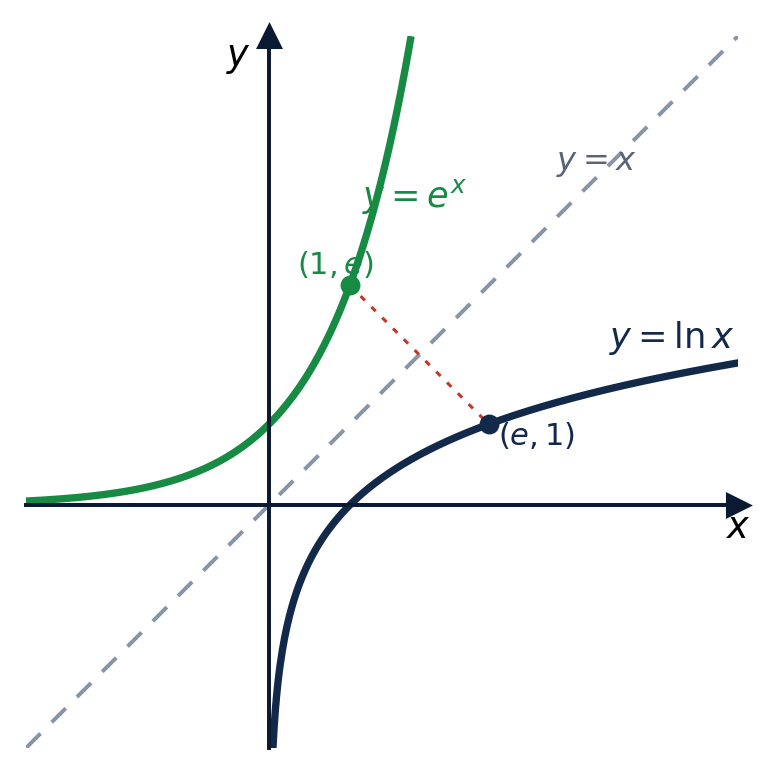
ln et exp sont réciproques
Courbes symétriques par rapport à y=x
y=lnx et y=ex : symétriques par rapport à y=x (points (e,1) et (1,e)).
★ Astuces géniales
Domaine d'abord : ln n'existe que pour un argument >0.
Transformer produits/quotients en sommes avec les propriétés.